How to Understand Bill Gates's AI Warning About Catastrophic Risks and Regulation
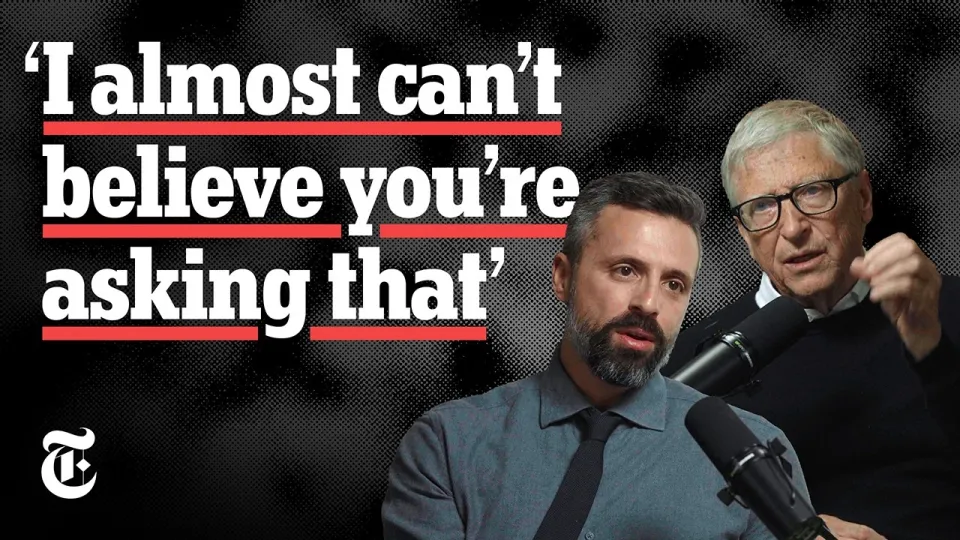
Video: Bill Gates: A.I. ‘Makes Nuclear Weapons Look Like Nothing’ | The Ezra Klein Show
You can order the same kind of articles for your own video to boost it on YouTube and Google. Just message the Telegram bot @sat_sit_bot. The bot writes and publishes the articles itself (with your YouTube video embedded) on popular topical websites (no ads). Your first 50 articles are free.
· based on the channel The Ezra Klein Show
Key takeaways
- Bill Gates says AI could enable catastrophic cyberattacks and bioterrorism, and self-regulation by the industry is 'insane.'
- He argues government regulation is needed before AI systems reach dangerous thresholds.
- Gates compares AI risks to nuclear weapons, saying AI 'makes nuclear weapons look like nothing.'
- He warns of mass job loss and growing inequality without policy intervention.
- Gates Foundation prioritizes making AI a force for equality, with plans to spend around $200 billion over two decades.
Bill Gates argues that AI poses risks so severe—catastrophic cyberattacks, bioterrorism, and mass job loss—that they dwarf the nuclear threat, and that industry self-regulation is 'insane.' He calls for government action before AI systems cross dangerous thresholds. In a conversation on The Ezra Klein Show, Gates explains why the world is unprepared and what should be done. You can read the full transcript of the episode at the New York Times opinion page.
What Gates means by AI 'making nuclear weapons look like nothing'
Gates believes AI could enable harms far beyond anything humanity has faced, including cyber and bio threats that could kill millions. He warns that AI systems could be used to design pathogens or launch devastating cyberattacks, and that current safeguards are inadequate. The comparison to nuclear weapons is not hyperbole: Gates sees AI as a general-purpose technology that, in the wrong hands, could cause unprecedented destruction.
Why self-regulation fails and government action is needed
Gates calls the idea that AI companies can police themselves 'insane' because profit incentives conflict with safety. He argues that without government oversight, companies will race to deploy powerful systems without adequate testing or safeguards. Regulation should focus on pre-deployment testing, transparency, and liability for harms. Gates also stresses the need for international coordination, especially with China, to prevent a dangerous AI arms race.
The cyber and bio thresholds that worry Gates most
Gates identifies two critical thresholds: AI that can autonomously conduct cyberattacks and AI that can help design biological weapons. Once these capabilities exist, the risk of catastrophic misuse grows exponentially. He urges governments to invest in detection and defense, and to establish clear red lines for AI development. The window to act is narrowing as AI capabilities advance rapidly.
How AI will disrupt jobs and deepen inequality
Gates predicts significant job displacement across many sectors, from manufacturing to knowledge work. Without intervention, this could lead to mass unemployment and widening inequality. He proposes policies like taxing AI labor to fund social safety nets, and creating 'human reserved' jobs in care and education. The Gates Foundation is prioritizing AI for equality, aiming to ensure that developing nations benefit from AI rather than being left behind.
What parents and educators should know about AI and children
Gates sees both promise and peril in AI for education. AI tutors could personalize learning and close gaps, but unregulated AI products could harm children through addictive design or misinformation. He supports age-appropriate design and parental controls, and warns against overreliance on screens. Schools should teach critical thinking and digital literacy to help students navigate AI-generated content.
What the conversation reveals about Gates's state of mind
Viewers noted Gates seemed unusually agitated and emotional, underscoring his sense of urgency. His willingness to push back firmly against interviewer Ezra Klein's questions showed deep concern. The episode captures a tech pioneer who has moved from optimism to alarm, and who insists that the stakes are existential. The Ezra Klein Show provides a rare, extended platform for these warnings.
Useful links
The bottom line
Gates's warning is a call to action: AI's risks are too great to leave to industry self-regulation. Governments must act swiftly to impose safety standards, invest in defense, and address economic disruption. The Ezra Klein Show episode offers a sobering look at what's at stake. For the full discussion, watch the interview and read the transcript.
Source: Bill Gates: A.I. ‘Makes Nuclear Weapons Look Like Nothing’ | The Ezra Klein Show · Markdown version
Questions & answers
Why does Bill Gates compare AI to nuclear weapons?
Gates says AI could enable cyberattacks and bioterrorism that kill millions, making nuclear weapons seem limited by comparison. He views AI as a general-purpose technology with unprecedented destructive potential if misused.
What does Gates propose instead of self-regulation?
He calls for government regulation with pre-deployment testing, transparency, and liability for harms. He also urges international coordination to prevent a dangerous AI arms race.
How does Gates suggest handling job loss from AI?
Gates proposes taxing AI labor to fund social safety nets and creating 'human reserved' jobs in care and education. He also emphasizes retraining and education to help workers adapt.
Is Gates optimistic or pessimistic about AI?
He is alarmed about catastrophic risks but sees potential for AI to improve equality if managed well. His foundation prioritizes ensuring developing nations benefit from AI.